
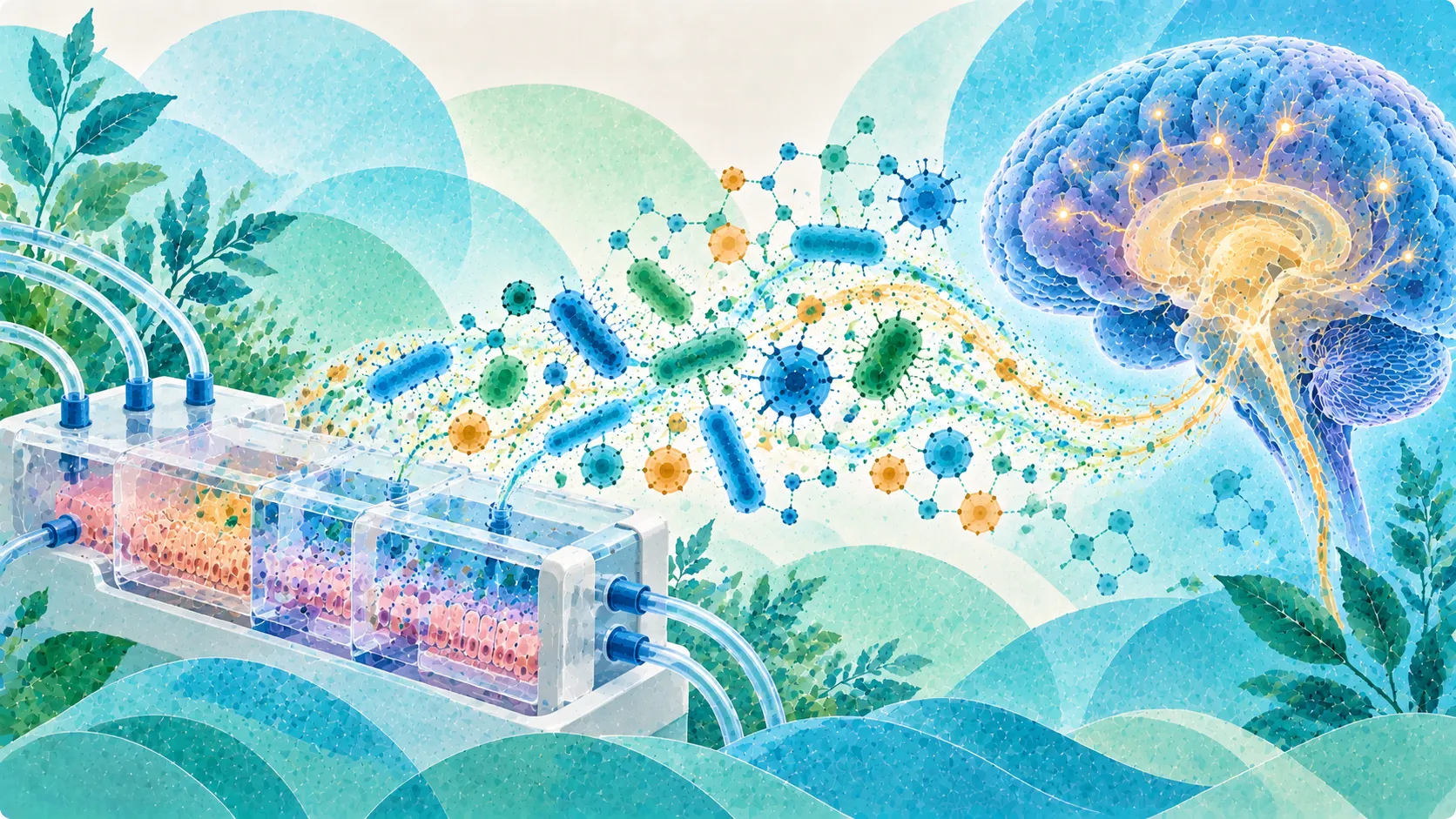
The gut-brain axis (GBA) represents a complex, bidirectional communication network between the gastrointestinal tract and the central nervous system. This axis involves neural, hormonal, and immunological signaling pathways, with the vagus nerve, microbial metabolites, and immune mediators playing central roles (Carabotti et al., 2015). Emerging evidence underscores its significance in maintaining physiological homeostasis and its involvement in various neurological disorders, including Parkinson’s disease, Alzheimer’s disease, and depression (Cryan et al., 2019).
To elucidate the underlying mechanisms and facilitate drug development, researchers have turned to organ-on-a-chip (OoC) technology, creating microphysiological systems that replicate the GBA in vitro. These platforms integrate microfluidic engineering with living cells to simulate organ-level functions under dynamic flow conditions, offering a more physiologically relevant alternative to traditional static cultures or animal models (Bhatia & Ingber, 2014).
In the context of the GBA, these systems co-culture gut epithelial cells and neuronal cells, often incorporating additional components such as endothelial barriers to mimic the blood-brain barrier (BBB). For instance, a study developed a microfluidic-based GBA chip that allowed real-time observation of exosome transport from gut epithelial cells to neuronal cells, providing insights into intercellular communication mechanisms (Seo et al., 2024).
GBA-on-a-chip models have proven instrumental in studying the pathophysiology of neurodegenerative diseases. By introducing gut microbiota-derived metabolites and extracellular vesicles into the system, researchers observed their effects on neuronal cells, shedding light on the gut’s influence on neurodegeneration (Kim et al., 2024). These models have also been utilized to assess drug efficacy and transport; for example, the PEGASO platform evaluated the pharmacokinetics and neuroprotective impact of donepezil, an Alzheimer’s medication, across interconnected organ systems (Fanizza et al., 2025).
Moreover, GBA chips are being adapted to study inflammatory responses, microbiome-host interactions, and BBB permeability changes under pathological conditions such as gut dysbiosis and systemic inflammation. Dysbiosis has been shown to increase gut permeability, allowing microbial metabolites and pro-inflammatory cytokines to enter systemic circulation and cross the BBB, exacerbating neuroinflammation—a key factor in neurological disorders such as Alzheimer’s and Parkinson’s disease (Kearns, 2024). These chips enable researchers to model these interactions in vitro, offering a controlled environment to dissect the molecular mechanisms involved.
For instance, studies have demonstrated that gut-derived metabolites, such as short-chain fatty acids and tryptophan derivatives, can modulate neuroinflammatory pathways and BBB integrity, and these effects can now be replicated and studied in microfluidic GBA platforms (Trisal et al., 2025). Additionally, stroke models have shown that gut microbiota alterations can lead to immune cell infiltration into the brain via a compromised BBB, a phenomenon that GBA chips are increasingly being used to simulate (Huang & Xia, 2021).
These platforms are also paving the way for personalized medicine, enabling patient-specific modeling using induced pluripotent stem cells (iPSCs) and individual microbiota samples. This approach allows for the recreation of patient-specific gut-brain interactions, which is particularly valuable for studying heterogeneous diseases like autism spectrum disorder, multiple sclerosis, and depression (Trisal et al., 2025).
As the field advances, GBA-on-a-chip systems are expected to become indispensable tools in neurogastroenterology, drug screening, and precision medicine, offering unprecedented insights into the gut-brain dialogue and enabling the development of targeted therapies tailored to individual microbiome and genetic profiles.
REFERENCES
Bhatia, S. N., & Ingber, D. E. (2014). Microfluidic organs-on-chips. Nature Biotechnology, 32(8), 760–772. https://doi.org/10.1038/nbt.2989
Carabotti, M., Scirocco, A., Maselli, M. A., & Severi, C. (2015). The gut-brain axis: interactions between enteric microbiota, central and enteric nervous systems. Annals of Gastroenterology, 28(2), 203–209.
Cryan, J. F., O’Riordan, K. J., Cowan, C. S. M., et al. (2019). The microbiota-gut-brain axis. Physiological Reviews, 99(4), 1877–2013. https://doi.org/10.1152/physrev.00018.2018
Fanizza, F., Perottoni, S., Boeri, L., Donnaloja, F., Negro, F., Pugli, F., Forloni, G., Giordano, C., & Albani, D. (2025). A gut-brain axis on-a-chip platform for drug testing challenged with donepezil. Lab on a chip, 25(7), 1854–1874. https://doi.org/10.1039/d4lc00273c
Huang, Q., & Xia, J. (2021). Influence of the gut microbiome on inflammatory and immune response after stroke. Neurological sciences : official journal of the Italian Neurological Society and of the Italian Society of Clinical Neurophysiology, 42(12), 4937–4951. https://doi.org/10.1007/s10072-021-05603-6
Kearns R. (2024). Gut-Brain Axis and Neuroinflammation: The Role of Gut Permeability and the Kynurenine Pathway in Neurological Disorders. Cellular and molecular neurobiology, 44(1), 64. https://doi.org/10.1007/s10571-024-01496-z
Kim, N. Y., Lee, H. Y., Choi, Y. Y., Mo, S. J., Jeon, S., Ha, J. H., Park, S. D., Shim, J. J., Lee, J., & Chung, B. G. (2024). Effect of gut microbiota-derived metabolites and extracellular vesicles on neurodegenerative disease in a gut-brain axis chip. Nano convergence, 11(1), 7. https://doi.org/10.1186/s40580-024-00413-w
Seo, G. M., Lee, H., Kang, Y. J., Kim, D., & Sung, J. H. (2024). Development of in vitro model of exosome transport in microfluidic gut-brain axis-on-a-chip. Lab on a chip, 24(19), 4581–4593. https://doi.org/10.1039/d4lc00490f
Trisal, A., Singh, I., Garg, G., Jorwal, K., & Singh, A. K. (2025). Gut-brain axis and brain health: modulating neuroinflammation, cognitive decline, and neurodegeneration. 3 Biotech, 15(1), 25. https://doi.org/10.1007/s13205-024-04187-0