
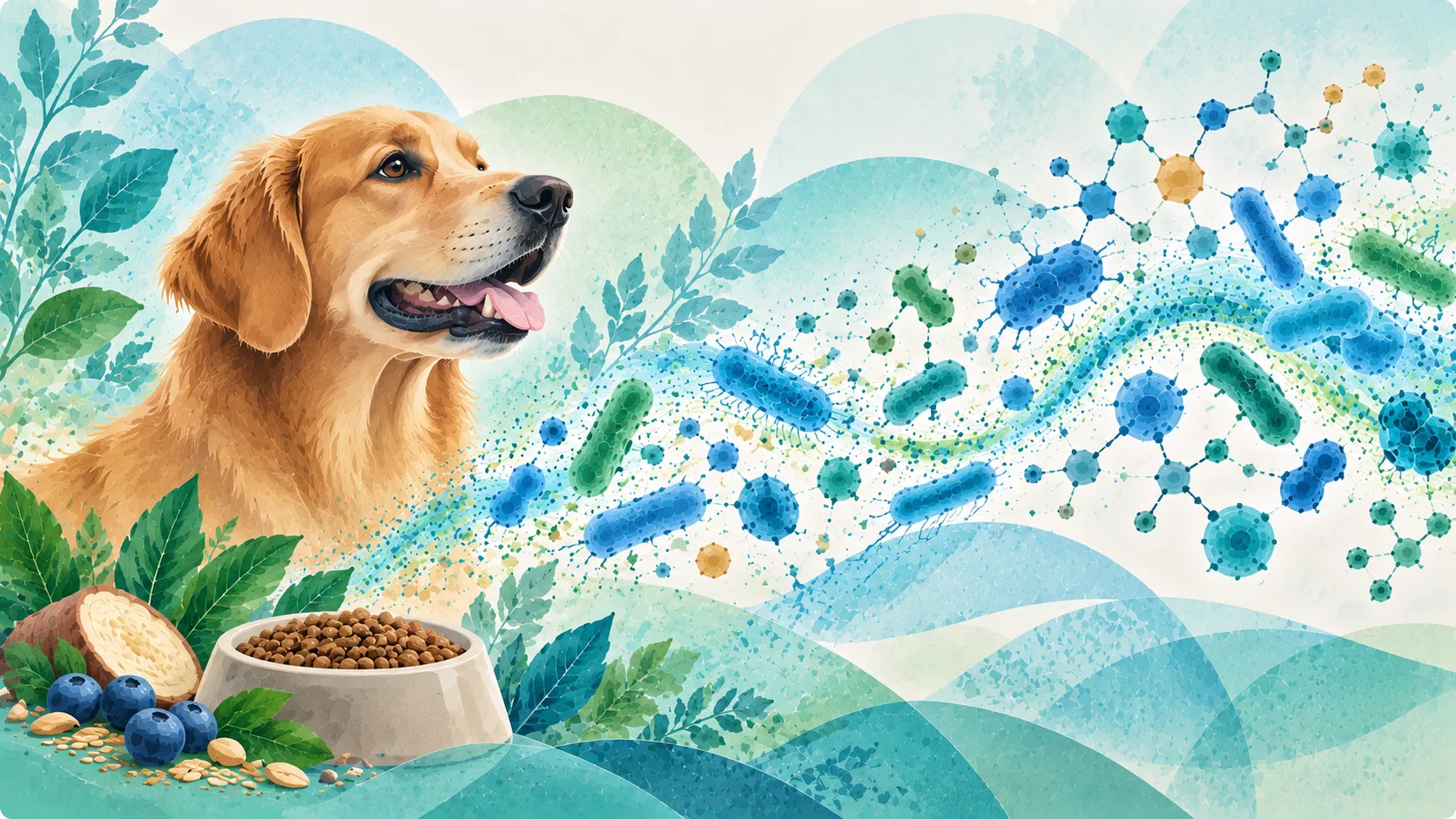
Alterations in the gastrointestinal (GI) microbiome have been documented in dogs with conditions such as acute uncomplicated diarrhea, acute hemorrhagic diarrhea syndrome, parvoviral enteritis, and chronic enteropathies. Although the exact cause-and-effect relationships are still being clarified, strong evidence indicates that resident GI microorganisms play a critical role in disease development and overall health. This has led to growing interest in therapeutic strategies that modulate the gut microbiota to restore balance and improve outcomes (Schmid & Tolbert, 2024).
One such approach involves biotics—a collective term for prebiotics, probiotics, synbiotics, and postbiotics. These agents aim to support gut health by influencing microbial populations and their metabolic activity.
- Prebiotics are non-digestible substrates that selectively stimulate beneficial bacteria.
- Probiotics are live microorganisms that confer health benefits when administered in adequate amounts.
- Synbiotics combine prebiotics and probiotics for synergistic effects.
- Postbiotics, the newest category, consist of inactivated microorganisms and/or their bioactive metabolites that provide health benefits without requiring live cells.
As research advances, biotics are gaining attention not only for their role in maintaining gut homeostasis but also for their potential to modulate immunity, reduce inflammation, and serve as alternatives to antimicrobials in veterinary medicine.
PREBIOTICS
Patra (2011) conducted a meta-analysis assessing the effects of prebiotics on canine digestion, gut microbiota, and immune function. The findings revealed that higher prebiotic inclusion increased short-chain fatty acid (SCFA) levels and significantly promoted beneficial bacteria such as bifidobacteria and lactobacilli, particularly in dogs with low initial counts. The study concluded that incorporating prebiotics—up to approximately 1.4% of the diet—can enhance intestinal health by supporting microbial balance and SCFA production.
More recent research further demonstrates that supplementing diets with prebiotic fibers, such as those derived from red ginseng, or using synbiotic combinations, improves microbial diversity, boosts SCFA-producing bacteria, and reduces pathogenic species (Montserrat-Malagarriga et al., 2024; Song et al., 2023).
An in vitro fermentation study by Zhang et al. (2023) evaluated five oligosaccharides—FOS, GOS, MOS, RFN, and PDX—using canine fecal inoculum. The results showed that these fibers selectively encouraged beneficial microbial growth while limiting potentially harmful populations. Each oligosaccharide demonstrated distinct effects on the composition and abundance of gut microbes. Moreover, their inclusion significantly increased short-chain fatty acid production, particularly butyric acid, a key metabolite linked to improved intestinal health.
PROBIOTICS
Probiotics have demonstrated beneficial effects on gut health and may help alleviate certain intestinal disorders in dogs, although their precise mechanisms of action remain largely unclear (Yang & Wu, 2023). Most probiotics studied in canine nutrition belong to the genera Lactobacillus, Bifidobacterium, and Enterococcus (Wernimont et al., 2020). While many strains hold Qualified Presumption of Safety (QPS) status from EFSA, the agency has not confirmed efficacy for any specific strain to date—though some have been labeled as “potentially efficacious.”
Similar to findings in human health, the physiological effects of probiotics in dogs are strain-specific. For example, supplementation with a commercial Enterococcus faecium strain has been shown to enhance immune responsiveness in healthy puppies, whereas a multistrain formulation containing Lactobacillus, Bifidobacterium, and Streptococcus species has been associated with improved intestinal barrier integrity through strengthened tight junctions (Schmid & Tolbert, 2024).
SYNBIOTICS
In a randomized controlled trial, researchers investigated the effects of a combined probiotic/synbiotic supplement—comprising a commercial yeast-based synbiotic strain and a multi-strain bacterial synbiotic—on the gut microbiome and metabolome of healthy dogs undergoing antibiotic therapy. Dogs receiving the supplement exhibited a more favorable recovery trajectory compared to those given a placebo: their microbiome composition, dysbiosis index, and several metabolomic pathways (including short-chain fatty acids, bile acids, and tryptophan metabolites) rebounded more rapidly and more completely. These findings suggest that synbiotics may help counteract antibiotic-induced disruptions in intestinal microbial and metabolic health in dogs (Whittemore et al., 2021).
In a randomized controlled trial, Whittemore et al. (2021) examined the impact of a combined probiotic/synbiotic supplement on the gut microbiome and metabolome of healthy dogs undergoing an antibiotic treatment. The supplement consisted on a commercial yeast-based synbiotic (Saccharomyces boulardii and beta-glucan), and a multi-strain bacterial product. Dogs supplemented with the product demonstrated a more favorable recovery compared to the placebo group: their microbiome composition, dysbiosis index, and key metabolomic pathways (including short-chain fatty acids, bile acids, and tryptophan metabolites) normalized more rapidly and completely. These findings suggest that synbiotics may help mitigate antibiotic-induced disruptions in intestinal microbial and metabolic health in dogs.
POSTBIOTICS
In 2021, the International Scientific Association of Probiotics and Prebiotics (ISAPP) defined postbiotics as preparations of inactivated microorganisms and/or their components that provide health benefits to the host. These bioactive compounds—produced by beneficial microorganisms during fermentation—include bacteriocins, short-chain fatty acids, vitamins, and cofactors (Schmid & Tolbert, 2024).
Postbiotics are a relatively new topic in veterinary medicine, particularly for dogs, which explains the mixed findings in current research. A meta-analysis by Bonel-Ayuso et al. (2025) found no significant effects, yet highlighted promising evidence from other studies:
- Immunomodulation: Postbiotic supplements, such as yeast-derived scFOS, improved immune markers in dogs by increasing the CD4+:CD8+ T-cell ratio and supporting mucosal IgA responses. Saccharomyces cerevisiae fermentation products also boosted monocytes, antigen-presenting B cells, helper T cells, and IFN-γ-producing cytotoxic T cells, while reducing TNF-α production upon TLR stimulation.
- Anti-inflammatory effects: Dogs under stress receiving Saccharomyces cerevisiae postbiotics showed higher IL-10 (anti-inflammatory) and stable levels of pro-inflammatory cytokines (IL-8, MCP-1).
- Gut microbiota modulation: Postbiotics from S. cerevisiae and lactic acid bacteria improved gut diversity and increased beneficial taxa.
Overall, these findings suggest postbiotics may support immune function, reduce inflammation, and enhance gut health in dogs, warranting further research.
Despite their growing popularity, the evidence supporting the benefits of prebiotics, probiotics, and synbiotics in dogs remains limited. Research gaps persist regarding strain-specific effects, optimal combinations, dosing strategies, and long-term safety. Moreover, promising in vitro findings often fail to translate into consistent in vivo outcomes (Schmitz & Suchodolski, 2016). These limitations underscore the need for well-designed, large-scale clinical trials to clarify efficacy and mechanisms of action. As interest in microbiome-targeted therapies continues to rise—driven by their potential to improve gut health, immunity, and reduce reliance on antimicrobials—future studies will be critical to establish evidence-based guidelines for their use in canine medicine.
REFERENCES
Bonel-Ayuso, D. P., Pineda-Pampliega, J., Martinez-Alesón García, P., Fernandez-Muela, M., de la Fuente, J., Garcia Fernandez, P. M., & Isabel Redondo, B. (2025). Effects of Postbiotic Administration on Canine Health: A Systematic Review and Meta-Analysis. Microorganisms, 13(7), 1572. https://doi.org/10.3390/microorganisms13071572
Montserrat-Malagarriga, M., Castillejos, L., Salas-Mani, A., Torre, C., & Martín-Orúe, S. (2024). Use of Different Synbiotic Strategies to Improve Gut Health in Dogs. Animals : an Open Access Journal from MDPI, 14. https://doi.org/10.3390/ani14233366
Patra A. K. (2011). Responses of feeding prebiotics on nutrient digestibility, faecal microbiota composition and short-chain fatty acid concentrations in dogs: a meta-analysis. Animal : an international journal of animal bioscience, 5(11), 1743–1750. https://doi.org/10.1017/S1751731111000887
Schmid, S. M., & Tolbert, M. K. (2024). Harnessing the microbiome: probiotics, antibiotics and their role in canine and feline gastrointestinal disease. The Veterinary record, 195(S2), 13–25. https://doi.org/10.1002/vetr.4915
Schmitz, S., & Suchodolski, J. (2016). Understanding the canine intestinal microbiota and its modification by pro-, pre- and synbiotics - what is the evidence?. Veterinary medicine and science, 2(2), 71–94. https://doi.org/10.1002/vms3.17
Song, H., Lee, J., Yi, S., Kim, W., Kim, Y., Namgoong, B., Choe, A., Cho, G., Shin, J., Park, Y., Kim, M., & Cho, S. (2023). Red Ginseng Dietary Fiber Shows Prebiotic Potential by Modulating Gut Microbiota in Dogs. Microbiology Spectrum, 11. https://doi.org/10.1128/spectrum.00949-23.
Wernimont, S. M., Radosevich, J., Jackson, M. I., Ephraim, E., Badri, D. V., MacLeay, J. M., Jewell, D. E., & Suchodolski, J. S. (2020). The Effects of Nutrition on the Gastrointestinal Microbiome of Cats and Dogs: Impact on Health and Disease. Frontiers in microbiology, 11, 1266. https://doi.org/10.3389/fmicb.2020.01266
Whittemore, J. C., Price, J. M., Moyers, T., & Suchodolski, J. S. (2021). Effects of Synbiotics on the Fecal Microbiome and Metabolomic Profiles of Healthy Research Dogs Administered Antibiotics: A Randomized, Controlled Trial. Frontiers in veterinary science, 8, 665713. https://doi.org/10.3389/fvets.2021.665713
Yang, Q., & Wu, Z. (2023). Gut Probiotics and Health of Dogs and Cats: Benefits, Applications, and Underlying Mechanisms. Microorganisms, 11(10), 2452. https://doi.org/10.3390/microorganisms11102452
Zhang, Y., Ding, Z., Chen, X., Wen, M., Wang, Q., & Wang, Z. (2023). Effects of Oligosaccharide Fermentation on Canine Gut Microbiota and Fermentation Metabolites in an In Vitro Fecal Fermentation Model. Fermentation, 9(8), 722. https://doi.org/10.3390/fermentation9080722