
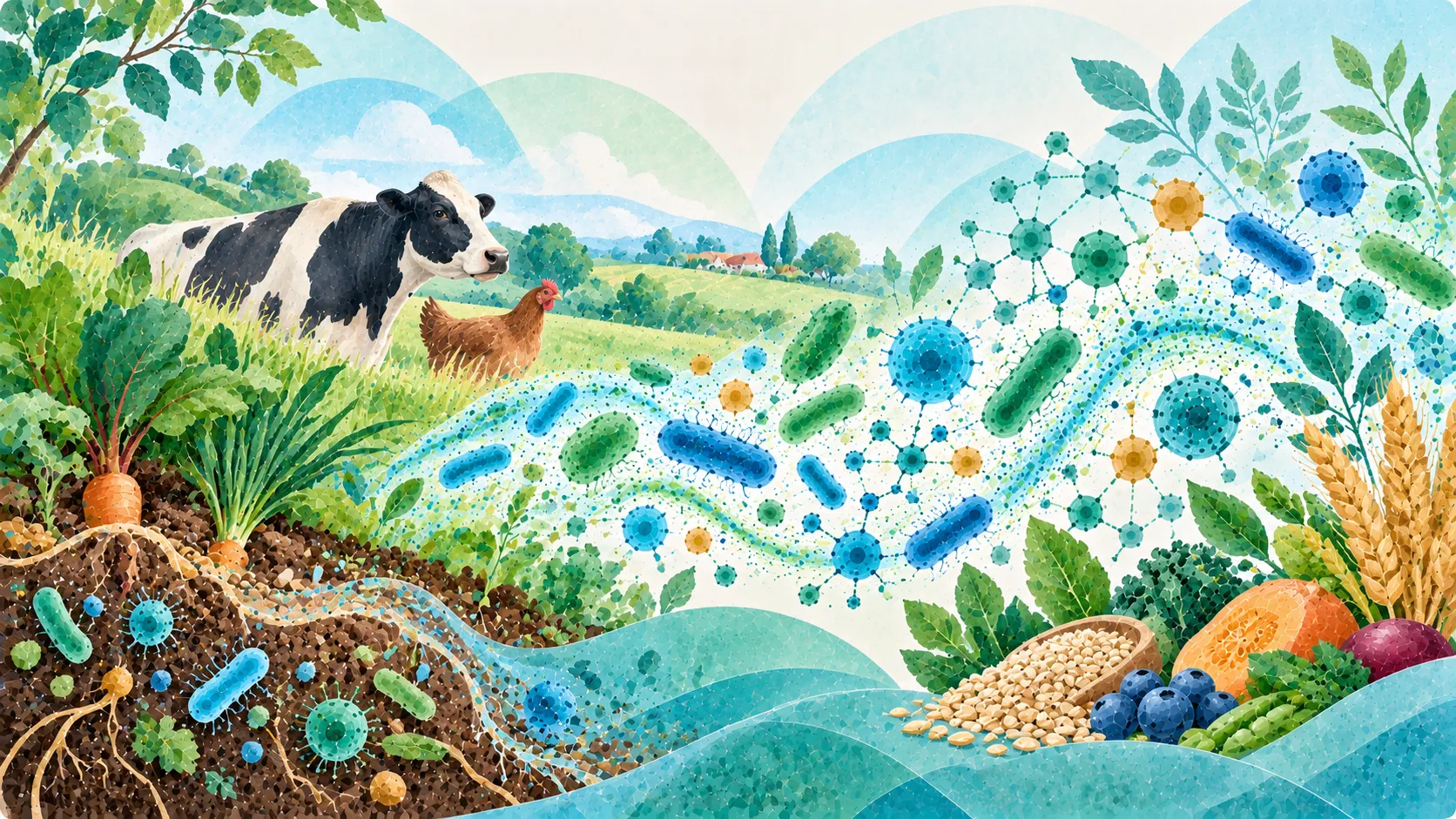
Probiotics and prebiotics are increasingly used in animal husbandry as sustainable tools to promote health and productivity, particularly since the use of antibiotics for growth promotion has been banned in many countries. Growing concerns about antimicrobial resistance (AMR) have led to stricter regulations and global efforts to limit the non-therapeutic use of antibiotics in livestock. Although antibiotics remain essential for disease treatment, probiotics and prebiotics serve a complementary role, supporting gut health, enhancing nutrient absorption, and strengthening the animal’s overall resilience; thereby contributing to responsible antibiotic stewardship.
Performance and health outcomes in livestock
The supplementation of probiotics and prebiotics in livestock diets has consistently demonstrated measurable improvements in growth performance, feed efficiency, immune function, and disease resistance across species (Arsène et al., 2021; Usman et al., 2025; Uyeno et al., 2015). These benefits are largely mediated through the modulation of gut microbiota, enhancement of nutrient absorption, and regulation of host immune responses (Ducatelle et al., 2015; Markowiak & Śliżewska, 2018).
Probiotics have shown particular efficacy in reducing gastrointestinal pathogens, notably Clostridium perfringens and Salmonella spp., thereby improving gut integrity and reducing disease incidence (Sachdeva et al., 2025). This antimicrobial effect is attributed to competitive exclusion, production of bacteriocins, and stimulation of mucosal immunity (Gadde et al., 2017).
In ruminants, strains of Lactobacillus, Bifidobacterium, and Saccharomyces have been shown to enhance rumen fermentation, improve fiber digestibility, and increase milk yield. Prebiotics such as inulin and fructooligosaccharides (FOS) further support beneficial microbial populations and contribute to methane reduction (Yue et al., 2025). Synbiotics (combinations of probiotics and prebiotics) offer synergistic benefits, promoting intestinal health, microbial balance, and overall productivity (Markowiak & Śliżewska, 2018). Controlled trials confirm these advantages: for example, FOS combined with Lactiplantibacillus plantarum improved nutrient digestibility, antioxidant status, immune markers, and reduced diarrhea in dairy calves (Sharma et al., 2024).
In pigs, supplementation with probiotics and prebiotics enhances gut integrity, feed efficiency, and growth performance while reducing diarrhea and pathogenic load; synbiotics further stimulate short-chain fatty acid production and strengthen mucosal immunity (Atuahene et al., 2025).
Poultry also benefits from these interventions, with improved gut microbiota balance, carcass yield, and resistance to enteric pathogens. Probiotics such as L. plantarum and Bacillus spp. play key roles in growth and egg quality, while prebiotics and synbiotics reinforce gut barrier function and help mitigate antimicrobial resistance risks (Halder et al., 2024).
Challenges and the need for evidence-based application
Despite their promising potential, not all probiotic and prebiotic formulations deliver consistent results across livestock systems. Variability in strain specificity, dosage, animal species, age, diet composition, and environmental conditions can significantly influence outcomes. For instance, a probiotic strain effective in poultry may not yield the same benefits in ruminants or swine due to differences in gut physiology and microbial ecology (Markowiak & Śliżewska, 2018; Uyeno et al., 2015).
Moreover, the stability of probiotic cultures during feed processing and storage, as well as their viability through the gastrointestinal tract, remains a technical hurdle. Some strains may not survive pelleting temperatures or acidic gastric environments, reducing their functional efficacy by the time they reach the intestine (Gadde et al., 2017).
Another challenge lies in the lack of standardized protocols for evaluating probiotic and prebiotic efficacy. Many studies differ in experimental design, endpoints measured, and statistical rigor, making cross-study comparisons difficult and sometimes inconclusive (Ducatelle et al., 2015). This underscores the need for rigorous, reproducible, and species-specific trials to validate functional claims.
Finally, while the market for feed additives is rapidly expanding, regulatory frameworks often lag behind scientific advancements. Clearer guidelines on strain documentation, safety assessment, and health claims are essential to ensure that only well-characterized and effective products reach the field (Arsène et al., 2021).
In this context, evidence-based application is not just a scientific ideal; it’s a practical necessity. Tailoring interventions to specific production systems, supported by robust data, will be key to unlocking the full potential of microbiome-targeted strategies in animal health and performance.
REFERENCES
Arsène, M., Davares, A., Andreevna, S., Vladimirovich, E., Carime, B., Marouf, R., & Khelifi, I. (2021). The use of probiotics in animal feeding for safe production and as potential alternatives to antibiotics. Veterinary World, 14, 319 - 328. https://doi.org/10.14202/vetworld.2021.319-328.
Atuahene, D., Sam, B. A., Idan, F., Sana, S. S., Knop, R., Suthar, T., Kumar, H., & Shaikh, A. M. (2025). Probiotics, Prebiotics, and Synbiotics in Pigs and Poultry: A Review of Gut Health, Performance, and Environmental Outcomes. Veterinary Sciences, 12(11), 1054. https://doi.org/10.3390/vetsci12111054
Ducatelle, R., Eeckhaut, V., Haesebrouck, F., & Immerseel, F. (2015). A review on prebiotics and probiotics for the control of dysbiosis: present status and future perspectives. Animal : an international journal of animal bioscience, 9 1, 43-8 . https://doi.org/10.1017/S1751731114002584.
Gadde, U., Kim, W. H., Oh, S. T., & Lillehoj, H. S. (2017). Alternatives to antibiotics for maximizing growth performance and feed efficiency in poultry: a review. Animal health research reviews, 18(1), 26–45. https://doi.org/10.1017/S1466252316000207
Halder, N., Sunder, J., De, A. K., Bhattacharya, D., & Joardar, S. N. (2024). Probiotics in poultry: A comprehensive review. The Journal of Basic and Applied Zoology, 85, 23. https://doi.org/10.1186/s41936-024-00379-5
Markowiak, P., & Śliżewska, K. (2018). The role of probiotics, prebiotics and synbiotics in animal nutrition. Gut Pathogens, 10. https://doi.org/10.1186/s13099-018-0250-0.
Sachdeva, A., Tomar, T., Malik, T., Bains, A., & Karnwal, A. (2025). Exploring probiotics as a sustainable alternative to antimicrobial growth promoters: mechanisms and benefits in animal health. Frontiers in Sustainable Food Systems. https://doi.org/10.3389/fsufs.2024.1523678.
Sharma, A. N., Chaudhary, P., Grover, C. R., Kumar, S., & Mondal, G. (2024). Impact of synbiotics on growth performance and gut health in Murrah buffalo calves. Veterinary research communications, 48(1), 179–190. https://doi.org/10.1007/s11259-023-10194-y
Usman, M., Noor, M., Ahmed, U., Khan, A., Ahmad, S., Khan, A., Rehman, A., Kazmi, S., Arshad, U., & Abdullah, O. (2025). Prebiotic and Probiotics Supplementation used in Animal Nutrition Have Their Effects on Gut Health and Animal Performance. Indus Journal of Bioscience Research. https://doi.org/10.70749/ijbr.v3i2.748.
Uyeno, Y., Shigemori, S., & Shimosato, T. (2015). Effect of Probiotics/Prebiotics on Cattle Health and Productivity. Microbes and Environments, 30, 126 - 132. https://doi.org/10.1264/jsme2.ME14176.
Yue, T., Lu, Y., Ding, W., Xu, B., Zhang, C., Li, L., Jian, F., & Huang, S. (2025). The Role of Probiotics, Prebiotics, Synbiotics, and Postbiotics in Livestock and Poultry Gut Health: A Review. Metabolites, 15(7), 478. https://doi.org/10.3390/metabo15070478