
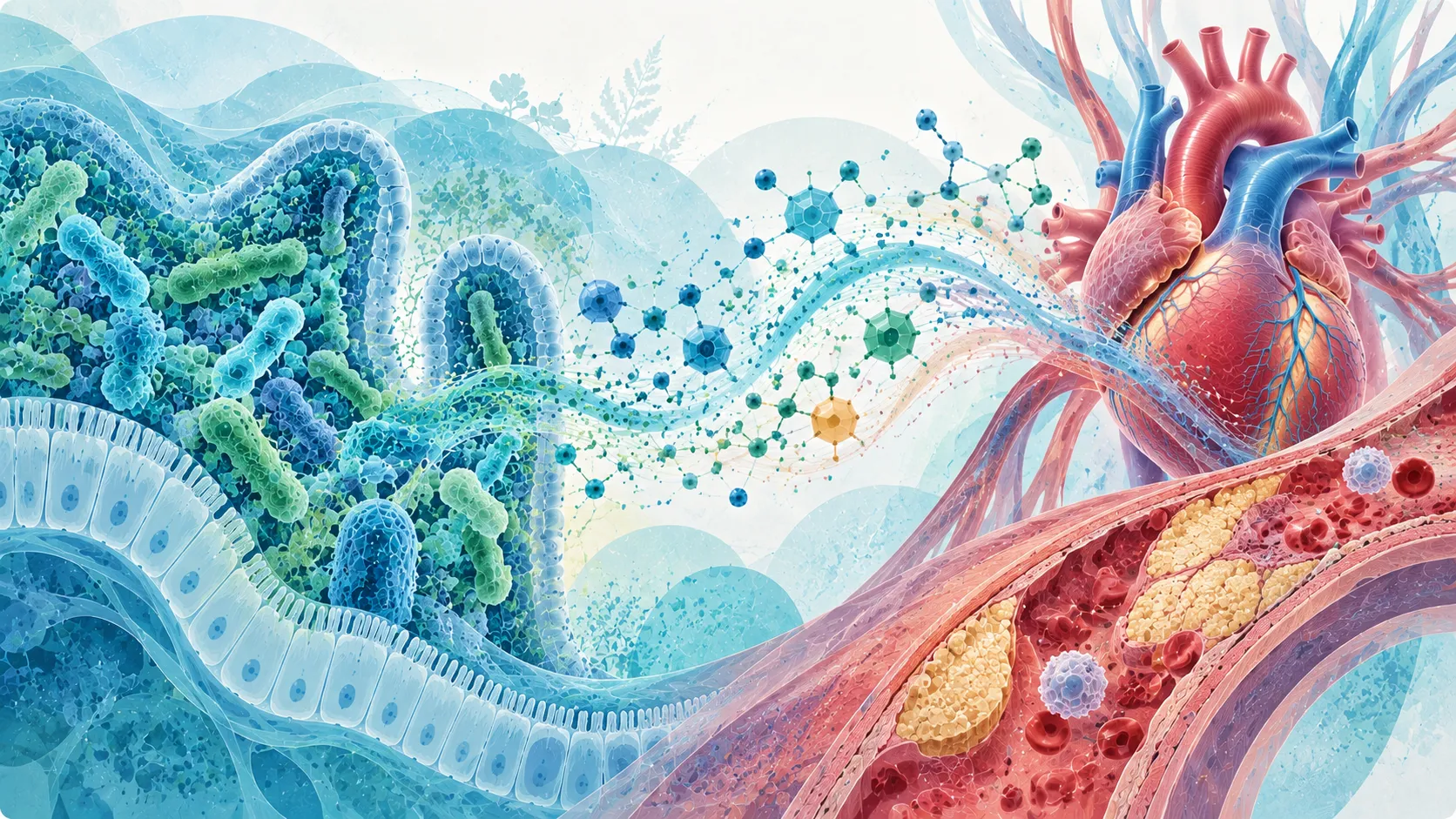
Atherosclerosis is traditionally understood as a multifactorial disease driven by dyslipidemia, hypertension, smoking, diabetes, and chronic vascular inflammation. However, these classical risk factors do not fully explain the residual cardiovascular risk observed in patients under optimal medical therapy.
In recent years, the gut–heart axis has emerged as a complementary framework linking intestinal microbial ecology with cardiovascular disease. The gut microbiota influences host physiology through microbial metabolites, immune modulation, intestinal barrier integrity, and diet–microbe interactions. Although strong associations are consistently observed in humans, causal inference remains incomplete, with mechanistic evidence primarily derived from experimental and translational studies (Jonsson & Bäckhed, 2017; Tang et al., 2017).
Recent advances in multi-omics, longitudinal cohort studies, and mechanistic experimentation have expanded the field from descriptive associations to pathway-level understanding of atherosclerosis (He et al., 2025; Tonch-Cerbu et al., 2025).
Mechanistic pathways linking the gut microbiota to atherosclerosis
Multiple metagenomic and clinical studies demonstrate that gut dysbiosis is associated with both subclinical and overt atherosclerotic cardiovascular disease (ASCVD). These include reduced microbial diversity, enrichment of pro-inflammatory taxa, and depletion of beneficial commensals (Jie et al., 2017; He et al., 2025).
Across populations, consistent microbial signatures have been reported, including increased abundance of the family Enterobacteriaceae, as well as genera such as Streptococcus, Eggerthella, Veillonella, and Megamonas, and the species Ruminococcus gnavus; alongside reduced SCFA-producing genera such as Roseburia and Bifidobacterium (Luqman et al., 2024; Muttiah & Hanafiah, 2025).
These findings suggest that atherosclerosis is associated with a reproducible microbial ecosystem characterized by reduced anti-inflammatory potential and increased pro-inflammatory capacity (Alexandrescu et al., 2024).
- Microbial metabolites
Among microbial metabolites, trimethylamine N-oxide (TMAO) is the most extensively studied. Produced from dietary choline and L-carnitine via microbial metabolism, TMAO promotes foam cell formation, endothelial dysfunction, platelet activation, and vascular inflammation. Elevated TMAO levels are consistently associated with adverse cardiovascular outcomes in humans (Sanchez-Rodríguez et al., 2020; Yoo et al., 2021).
Beyond TMAO, a landmark study identified imidazole propionate (ImP) as a microbiota-derived metabolite that directly contributes to endothelial dysfunction and atherosclerotic plaque formation. This work provided mechanistic evidence in experimental models and linked circulating ImP levels with subclinical atherosclerosis in humans, highlighting a novel therapeutic target (Mastrangelo et al., 2025).
Other metabolites, including phenylacetylglutamine and bile acid derivatives, are also emerging as modulators of vascular risk, although their clinical relevance remains under investigation (He et al., 2025; Tonch-Cerbu et al., 2025).
- Intestinal barrier dysfunction
Dysbiosis may impair epithelial barrier integrity, allowing bacterial products such as lipopolysaccharide (LPS) and peptidoglycan to translocate into the systemic circulation. These microbial components activate innate immune signaling, promote endothelial dysfunction, and amplify chronic low-grade inflammation, thereby contributing to plaque progression (Anto & Blesso, 2022; Lau et al., 2017; Tonch-Cerbu et al., 2025).
Short-chain fatty acids (SCFAs), particularly butyrate, may counteract these effects by strengthening epithelial barrier function and exerting anti-inflammatory effects, although human clinical evidence remains variable (Anto & Blesso, 2022; Verhaar et al., 2020).
- Immune and multi-organ interactions
The gut microbiota modulates systemic immunity through macrophage and T-cell regulation, influencing vascular inflammation throughout atherogenesis. Increasingly, cardiovascular disease is conceptualized as part of a broader multi-organ network involving the gut, liver, kidney, and heart.
Supporting this systems-level perspective, a recent multi-omics study demonstrated a gut microbiome–kidney–heart axis predictive of future cardiovascular disease, integrating microbiome composition with metabolic and clinical parameters (Chechi et al., 2026).
Therapeutic implications
Experimental studies suggest that the gut microbiota is not only a biomarker but also a modifiable contributor to atherosclerosis. In animal models, dysbiosis exacerbates metabolic dysfunction, inflammation, and atherosclerotic lesion formation (Shi et al., 2022).
Clinical and translational approaches currently under investigation include dietary interventions, probiotics, prebiotics, synbiotics, fecal microbiota transplantation (FMT), and targeted inhibition of microbial metabolic pathways (Rahman et al., 2022; Lima et al., 2025).
While some interventions, such as probiotic supplementation, have demonstrated changes in microbial diversity, robust evidence demonstrating cardiovascular outcome reduction in humans is still lacking (Sanchez-Rodríguez et al., 2020; Rahman et al., 2022; Lima et al., 2025).
Future perspectives
Recent reviews emphasize that future progress in the field depends on moving from association to causality and from taxonomy to function. Integrative multi-omics approaches are expected to refine cardiovascular risk prediction and identify actionable microbial pathways (Chakaroun et al., 2023; He et al., 2025).
The development of microbiome-targeted therapies, including enzyme inhibition and metabolite modulation, represents a promising direction for precision cardiovascular medicine (Chakaroun et al., 2023).
Conclusion
The gut microbiota is increasingly recognized as a key modulator of cardiovascular biology. Evidence supports a role for microbial metabolites, intestinal barrier dysfunction, and immune activation in linking dysbiosis to atherosclerosis.
Recent mechanistic and systems-level discoveries, including imidazole propionate and the gut–kidney–heart axis, have strengthened the biological plausibility of this relationship (Chechi et al., 2026; Mastrangelo et al., 2025).
However, causality in humans remains incompletely established, and microbiome-targeted therapies are still in early translational stages.
Future research will determine whether modulation of the gut microbiome can translate into clinically meaningful reductions in cardiovascular disease.
REFERENCES
Alexandrescu, L., Suceveanu, A., Stanigut, A., Tofolean, D., Axelerad, A. D., Iordache, I., Herlo, A., Twakor, A. N., Nicoara, A. D., Tocia, C., Dumitru, A., Dumitru, E., Condur, L., Aftenie, C. F., & Tofolean, I. (2024). Intestinal insights: The gut microbiome's role in atherosclerotic disease: A narrative review. Microorganisms, 12. https://doi.org/10.3390/microorganisms12112341
Anto, L., & Blesso, C. (2022). Interplay between diet, the gut microbiome, and atherosclerosis: Role of dysbiosis and microbial metabolites on inflammation and disordered lipid metabolism. The Journal of Nutritional Biochemistry. https://doi.org/10.1016/j.jnutbio.2022.108991
Chakaroun, R. M., Olsson, L. M., & Bäckhed, F. (2023). The potential of tailoring the gut microbiome to prevent and treat cardiometabolic disease. Nature Reviews Cardiology, 20(4), 217–235. https://doi.org/10.1038/s41569-022-00771-0
Chechi, K., Chakaroun, R., Myridakis, A., et al. (2026). A gut microbiome–kidney–heart axis predictive of future cardiovascular diseases. Nature Communications, 17, 3477. https://doi.org/10.1038/s41467-026-69405-0
He, J. H., Wang, H., Qiu, E., Qi, Q., & Wang, Z. (2025). Gut microbiota and atherosclerosis: Integrative multi-omics and mechanistic insights. Current Atherosclerosis Reports, 28. https://doi.org/10.1007/s11883-025-01371-2
Jie, Z., Xia, H., Zhong, S.-L., Feng, Q., Li, S., Liang, S., Zhong, H., Liu, Z., Gao, Y., Zhao, H., Zhang, D., Su, Z., Fang, Z., Lan, Z., Li, J., Xiao, L., Li, J., Li, R., Li, X., . . . Kristiansen, K. (2017). The gut microbiome in atherosclerotic cardiovascular disease. Nature Communications, 8. https://doi.org/10.1038/s41467-017-00900-1
Jonsson, A., & Bäckhed, F. (2017). Role of gut microbiota in atherosclerosis. Nature Reviews Cardiology, 14, 79–87. https://doi.org/10.1038/nrcardio.2016.183
Lau, K., Srivatsav, V., Rizwan, A., Nashed, A., Liu, R., Shen, R., & Akhtar, M. (2017). Bridging the Gap between Gut Microbial Dysbiosis and Cardiovascular Diseases. Nutrients, 9. https://doi.org/10.3390/nu9080859
Lima, T., Costa, V., Nunes, C., Da Silva, G. J., & Domingues, S. (2025). From Dysbiosis to Cardiovascular Disease: The Impact of Gut Microbiota on Atherosclerosis and Emerging Therapies. Applied Sciences. https://doi.org/10.3390/app15137084
Luqman, A., Hassan, A., Ullah, M., Naseem, S., Ullah, M., Zhang, L., Din, A., Ullah, K., Ahmad, W., & Wang, G. (2024). Role of the intestinal microbiome and its therapeutic intervention in cardiovascular disorder. Frontiers in Immunology, 15. https://doi.org/10.3389/fimmu.2024.1321395
Muttiah, B., & Hanafiah, A. (2025). Gut microbiota and cardiovascular diseases: Unraveling the role of dysbiosis and microbial metabolites. International Journal of Molecular Sciences, 26. https://doi.org/10.3390/ijms26094264
Rahman, M., Islam, F., Or-Rashid, M. H., Mamun, A., Rahaman, M. S., Islam, M., Meem, A. F. K., Sutradhar, P. R., Mitra, S., Mimi, A. A., Emran, T., F., Idroes, R., Tallei, T., Ahmed, M., & Cavalu, S. (2022). The Gut Microbiota (Microbiome) in Cardiovascular Disease and Its Therapeutic Regulation. Frontiers in Cellular and Infection Microbiology, 12. https://doi.org/10.3389/fcimb.2022.903570
Sanchez-Rodríguez, E., Egea-Zorrilla, A., Plaza-Díaz, J., Aragón‐Vela, J., Muñoz-Quezada, S., Tercedor-Sánchez, L., & Abadía-Molina, F. (2020). The Gut Microbiota and Its Implication in the Development of Atherosclerosis and Related Cardiovascular Diseases. Nutrients, 12. https://doi.org/10.3390/nu12030605
Shi, G., Lin, Y., Wu, Y., Zhou, J., Cao, L., Chen, J.-Y., Li, Y., Tan, N., & Zhong, S. (2022). Bacteroides fragilis Supplementation Deteriorated Metabolic Dysfunction, Inflammation, and Aorta Atherosclerosis by Inducing Gut Microbiota Dysbiosis in Animal Model. Nutrients, 14. https://doi.org/10.3390/nu14112199
Tang, W. H. W., Kitai, T., & Hazen, S. L. (2017). Gut microbiota in cardiovascular health and disease. Circulation Research, 120, 1183–1196. https://doi.org/10.1161/CIRCRESAHA.117.309715
Tonch-Cerbu, A., Boicean, A., Stoia, O., & Teodoru, M. (2025). Gut microbiota-derived metabolites in atherosclerosis: Pathways, biomarkers, and targets. International Journal of Molecular Sciences, 26. https://doi.org/10.3390/ijms26178488
Verhaar, B., Prodan, A., Nieuwdorp, M., & Muller, M. (2020). Gut microbiota in hypertension and atherosclerosis: A review. Nutrients, 12. https://doi.org/10.3390/nu12102982
Yoo, J. Y., Sniffen, S., Percy, K. M. C., Pallaval, V. B., & Chidipi, B. (2021). Gut Dysbiosis and Immune System in Atherosclerotic Cardiovascular Disease (ACVD). Microorganisms, 10. https://doi.org/10.3390/microorganisms10010108