

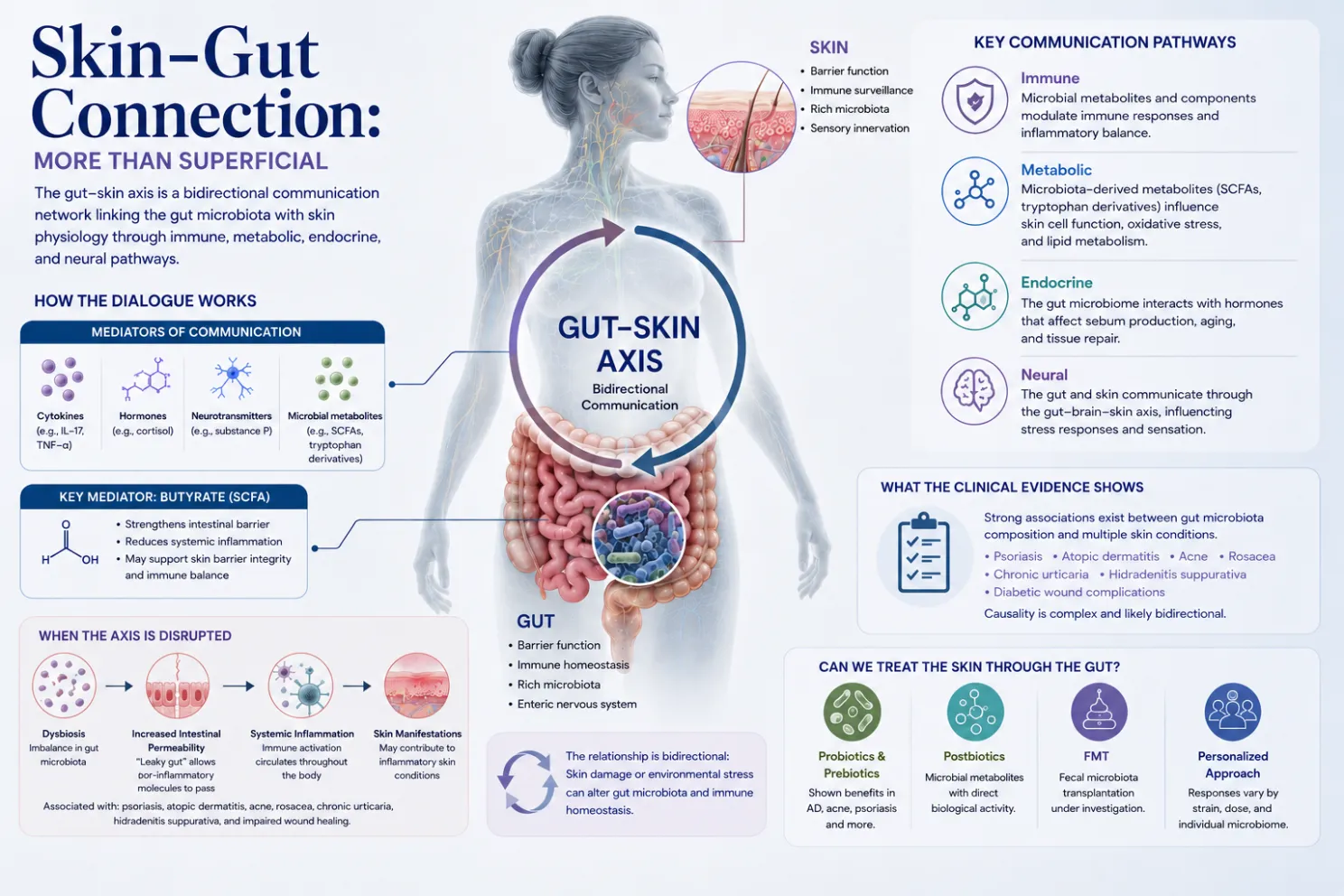
At first glance, the gut and the skin appear to be entirely separate systems. Yet biologically, they are closely aligned. Both function as barrier organs, are richly colonized by microbial communities, and are deeply integrated with the immune and nervous systems (Jimenez-Sanchez et al., 2025; O’Neill et al., 2016; Salem et al., 2018). This shared architecture enables continuous, dynamic communication between the two.
This dialogue is mediated through a range of signaling molecules, including cytokines, hormones, neurotransmitters, and microbial metabolites; most notably short-chain fatty acids (SCFAs) and tryptophan derivatives. Through these pathways, changes in the gut can influence skin physiology, while alterations in the skin can, in turn, affect gut function (De Pessemier et al., 2021; Mahmud et al., 2022; O’Neill et al., 2016; Stec et al., 2023). Among these mediators, butyrate stands out as a key regulator. Produced by gut bacteria, this SCFA plays a central role in maintaining intestinal barrier integrity, reducing systemic inflammation, and potentially modulating skin barrier function and immune balance (Criton & Joy, 2024; De Pessemier et al., 2021; Stec et al., 2023).
When the gut microbiota becomes imbalanced, the effects extend well beyond digestion. Increased intestinal permeability (often referred to as “leaky gut”) allows pro-inflammatory molecules to enter systemic circulation, triggering immune responses that can manifest in the skin. This mechanism has been associated with several dermatological conditions, including psoriasis, atopic dermatitis, rosacea, and chronic urticaria (Mahmud et al., 2022; Thye et al., 2022; Widhiati et al., 2021).
Importantly, this relationship is bidirectional. Skin damage, whether caused by physical injury or environmental stressors such as UV exposure, can also disrupt gut microbiota composition and intestinal immune homeostasis (Dokoshi et al., 2024; Jimenez-Sanchez et al., 2025; Lee & Kim, 2022).
The immune system acts as a central bridge in this axis. Structures such as gut-associated lymphoid tissue (GALT) and mucosa-associated lymphoid tissue (MALT) form interconnected immune networks, allowing inflammatory signals to propagate between gut and skin. Microbial metabolites further influence this cross-talk by regulating immune cell activity, particularly the balance between pro-inflammatory Th17 cells and anti-inflammatory Treg cells (De Pessemier et al., 2021; Gao et al., 2023; Patel et al., 2022).
Together, these interconnected pathways help explain why chronic inflammation often manifests concurrently in both gut and skin disorders.
What the clinical evidence shows
A growing body of research has identified strong associations between gut microbiota composition and multiple skin conditions, including:
- Psoriasis
- Atopic dermatitis
- Acne
- Rosacea
- Chronic urticaria
- Hidradenitis suppurativa
- Diabetic wound complications
(Chen et al., 2024; Gao et al., 2023; Haidar et al., 2025; Lee et al., 2018; Mahmud et al., 2022; Patel et al., 2022; Salem et al., 2018; Sinha et al., 2021; Thye et al., 2022; Widhiati et al., 2021; Zhao et al., 2025)
However, while these associations are consistent, causality remains an open question.
Does gut dysbiosis drive skin disease, or does systemic inflammation alter both simultaneously?
In many cases, the answer is likely both.
Can we improve skin health by targeting the gut?
One of the most exciting areas of gut–skin axis research is whether modifying the gut microbiome can become a therapeutic strategy for skin disease. Early clinical studies suggest that interventions targeting the intestinal microbiota may benefit conditions such as atopic dermatitis, acne, and psoriasis. Approaches under investigation include probiotics and prebiotics, which aim to restore microbial balance; postbiotics, including biologically active microbial metabolites; and fecal microbiota transplantation (FMT), a more intensive strategy currently being explored for selected indications (Criton & Joy, 2024; Gao et al., 2023; Parhizkar et al., 2025; Sinha et al., 2021; Zhao et al., 2025).
At the same time, the field has evolved rapidly. Since the gut–skin axis emerged as a major research focus, investigations have progressed from describing clinical associations to identifying specific microbial species and metabolites, elucidating gut and skin barrier mechanisms, and evaluating targeted microbiome-based therapies (Chen et al., 2024; De Pessemier et al., 2021; Frasier et al., 2025; Jimenez-Sanchez et al., 2025; O'Neill et al., 2016; Salem et al., 2018; Zhao et al., 2025).
Despite this progress, important questions remain. Therapeutic responses vary considerably between individuals and depend on factors such as microbial composition, strain selection, dosage, and host characteristics. Furthermore, key challenges, including establishing causal mechanisms, identifying reliable microbial biomarkers, and standardizing microbiome-based interventions, must be addressed before these approaches can be widely integrated into clinical practice. While the evidence is increasingly encouraging, there is not yet a universal microbiome-based therapy for skin disease.
References
Chen, M., Wang, R., & Wang, T. (2024). Gut microbiota and skin pathologies: Mechanism of the gut-skin axis in atopic dermatitis and psoriasis. International Immunopharmacology, 141, 112658. https://doi.org/10.1016/j.intimp.2024.112658
Criton, V., & Joy, S. (2024). Beyond skincare routines: Follow your gut to healthy skin – A review of the interplay between gut microbiome and skin. Journal of Skin and Sexually Transmitted Diseases. https://doi.org/10.25259/jsstd_49_2023
De Pessemier, B., Grine, L., Debaere, M., Maes, A., Paetzold, B., & Callewaert, C. (2021). Gut–skin axis: Current knowledge of the interrelationship between microbial dysbiosis and skin conditions. Microorganisms, 9. https://doi.org/10.3390/microorganisms9020353
Dokoshi, T., Chen, Y., Cavagnero, K., Rahman, G., Hakim, D., Brinton, S., Schwarz, H., Brown, E., O’Neill, A., Nakamura, Y., Li, F., Salzman, N., Knight, R., & Gallo, R. (2024). Dermal injury drives a skin-to-gut axis that disrupts the intestinal microbiome and immune homeostasis in mice. Nature Communications, 15. https://doi.org/10.1038/s41467-024-47072-3
Frasier, K., Johnson, A., & Fritts, H. (2025). The gut-skin axis: Unraveling the interplay between gut microbiota and dermatological health. Clinical Dermatology and Surgery. https://doi.org/10.61853/cfat2e68
Gao, T., Wang, X., Li, Y., & Ren, F. (2023). The role of probiotics in skin health and the gut–skin axis: A review. Nutrients, 15. https://doi.org/10.3390/nu15143123
Haidar, L., et al. (2025). Beyond the skin: Exploring the gut–skin axis in chronic spontaneous urticaria and other inflammatory skin diseases. Biomedicines, 13. https://doi.org/10.3390/biomedicines13082014
Jimenez-Sanchez, M., Celiberto, L., Yang, H., Sham, H., & Vallance, B. (2025). The gut-skin axis: A bi-directional, microbiota-driven relationship with therapeutic potential. Gut Microbes, 17. https://doi.org/10.1080/19490976.2025.2473524
Lee, H., & Kim, M. (2022). Skin barrier function and the microbiome. International Journal of Molecular Sciences, 23. https://doi.org/10.3390/ijms232113071
Lee, S., Lee, E., Park, Y., & Hong, S. (2018). Microbiome in the gut-skin axis in atopic dermatitis. Allergy, Asthma & Immunology Research, 10, 354–362. https://doi.org/10.4168/aair.2018.10.4.354
Mahmud, M., et al. (2022). Impact of gut microbiome on skin health: Gut-skin axis observed through therapeutics and skin diseases. Gut Microbes, 14. https://doi.org/10.1080/19490976.2022.2096995
O’Neill, C., Monteleone, G., McLaughlin, J., & Paus, R. (2016). The gut–skin axis in health and disease: A paradigm with therapeutic implications. BioEssays, 38. https://doi.org/10.1002/bies.201600008
Parhizkar, E., et al. (2025). Probiotics and gut microbiota modulation: Implications for skin health and disease management. Archives of Microbiology, 207. https://doi.org/10.1007/s00203-025-04267-6
Patel, B., Patel, K., Huang, R., Lee, C., & Moochhala, S. (2022). The gut-skin microbiota axis and its role in diabetic wound healing. International Journal of Molecular Sciences, 23. https://doi.org/10.3390/ijms23042375
Salem, I., Ramser, A., Isham, N., & Ghannoum, M. (2018). The gut microbiome as a major regulator of the gut-skin axis. Frontiers in Microbiology, 9. https://doi.org/10.3389/fmicb.2018.01459
Sinha, S., Lin, G., & Ferenczi, K. (2021). The skin microbiome and the gut-skin axis. Clinics in Dermatology, 39, 829–839. https://doi.org/10.1016/j.clindermatol.2021.08.021
Stec, A., et al. (2023). Bacterial metabolites: A link between gut microbiota and dermatological diseases. International Journal of Molecular Sciences, 24. https://doi.org/10.3390/ijms24043494
Thye, A., et al. (2022). Gut–skin axis: Unravelling the connection between the gut microbiome and psoriasis. Biomedicines, 10. https://doi.org/10.3390/biomedicines10051037
Widhiati, S., et al. (2021). The role of gut microbiome in inflammatory skin disorders: A systematic review. Dermatology Reports, 14. https://doi.org/10.4081/dr.2022.9188
Zhao, Y., Yu, C., Zhang, J., Yao, Q., Zhu, X., & Zhou, X. (2025). The gut-skin axis: Emerging insights in understanding and treating skin diseases through gut microbiome modulation. International Journal of Molecular Medicine, 56. https://doi.org/10.3892/ijmm.2025.5651