
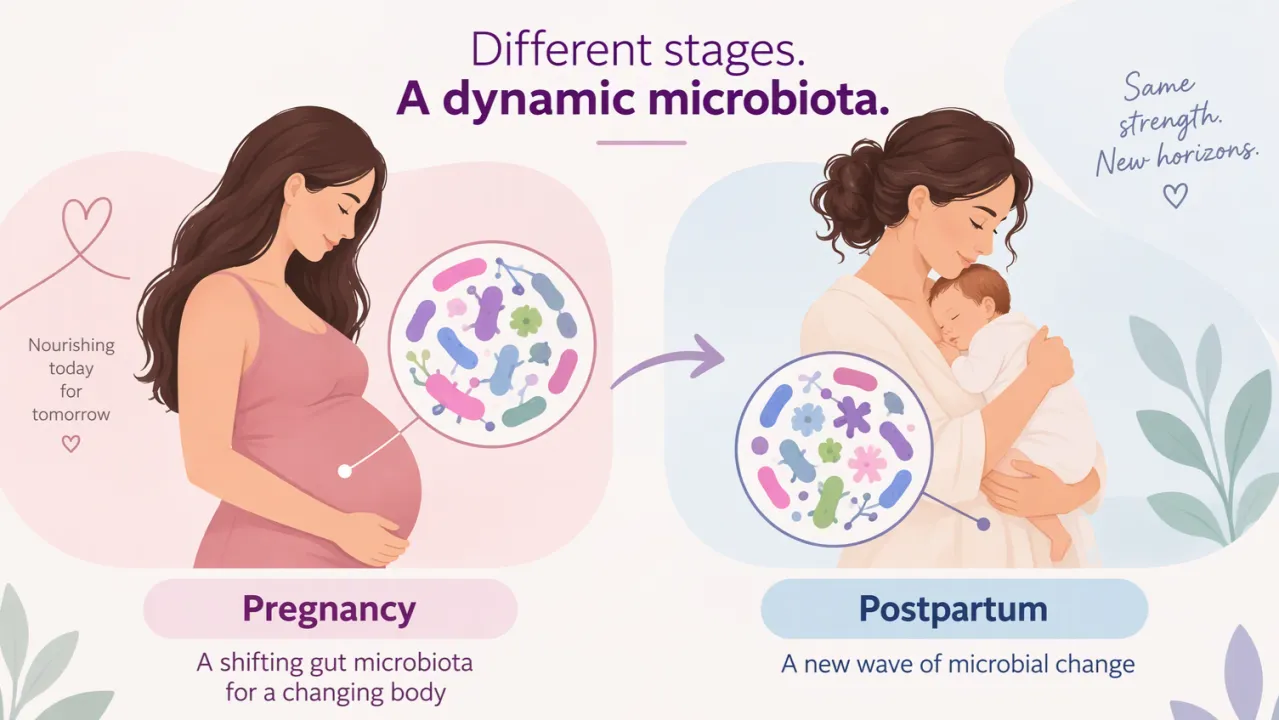
The maternal gut microbiota across pregnancy and postpartum
The gut microbiota comprises a diverse community of bacteria, archaea, fungi and viruses that inhabit the gastrointestinal tract and contribute to a range of host functions, including nutrient metabolism, maintenance of the intestinal barrier and regulation of immune responses. Disruptions to this community have been associated with numerous disorders, including metabolic diseases, chronic inflammatory conditions and neuropsychiatric disorders. Pregnancy is accompanied by profound physiological changes that affect many of the same systems influenced by the gut microbiota. As gestation progresses, maternal metabolism shifts to support fetal growth, with increased insulin resistance, greater energy storage and a state of controlled low-grade inflammation. At the same time, the maternal immune system undergoes extensive adaptation to maintain tolerance of the semi-allogeneic fetus while preserving protection against pathogens (Nuriel-Ohayon et al., 2016). Given the close interactions between the gut microbiota, metabolism and immune function, growing attention has focused on the potential role of the maternal microbiota in these pregnancy-associated adaptations (Koren et al., 2012; Pan et al., 2024).
In contrast, the postpartum period remains comparatively understudied despite representing another phase of major physiological transition. Childbirth is followed by rapid hormonal changes, the initiation of lactation, alterations in diet and lifestyle, sleep disruption and, in many cases, exposure to antibiotics. Each of these factors has the potential to influence the gut microbiota and its recovery following pregnancy (Weerasuriya et al., 2023).
Understanding how the maternal gut microbiota changes during both pregnancy and the postpartum period may provide important insights into maternal health, pregnancy outcomes and the establishment of the infant microbiome.
Gut microbiota changes during pregnancy
Evidence for pregnancy-associated changes in the gut microbiota has accumulated over the past decade, although the extent of these changes remains a matter of debate. In a landmark study, Koren et al. (2012) reported that the gut microbiota in early pregnancy closely resembled that of non-pregnant women, whereas samples collected in the third trimester showed reduced microbial richness, greater inter-individual variation, and increases in Pseudomonadota and Actinomycetota alongside a decline in several butyrate-producing taxa. However, not all studies have reached the same conclusions. Using dense longitudinal sampling, DiGiulio et al. (2015) observed relatively little change in gut microbial composition throughout pregnancy. More recent studies have generally supported the existence of gestational shifts, including reductions in alpha diversity and changes in the abundance of specific taxa. Similar patterns have been reported across geographically diverse populations, including participants in the Women First trial and several cohorts from China (Li et al., 2023; Pan et al., 2024; Tang et al., 2022).
Despite some inconsistencies, several trends emerge across the literature. The gut microbiota during the first trimester appears broadly similar to that of non-pregnant women, while later stages of pregnancy are often associated with a reduction in butyrate-producing bacteria and a relative increase in taxa linked to inflammatory processes (Koren et al., 2012; Li et al., 2023). In contrast, the magnitude and even the presence of changes in overall microbial diversity remain less clear. Differences in study design, population characteristics, sample size, sequencing approaches and sampling frequency likely contribute to the variability in findings. For example, the cohort studied by Koren et al. was recruited as part of a dietary and probiotic intervention, which may have influenced microbial trajectories (Tang et al., 2022). Furthermore, a large study including approximately 1,500 women found that individual variation explained a greater proportion of microbiota differences than gestational age itself, highlighting the substantial interpersonal heterogeneity of the maternal gut microbiome (Yang et al., 2020).
Maternal body mass index (BMI) is one of the factors most consistently associated with variation in the gut microbiota during pregnancy. Early studies reported differences in microbial composition between women with normal weight and those who were overweight or obese (Collado et al., 2008; Santacruz et al., 2010). Later work found that obesity was associated with a distinct third-trimester microbiota profile accompanied by elevated markers of systemic inflammation (Zacarías et al., 2018). Both pre-pregnancy BMI and gestational weight gain have also been linked to differences in microbial composition during pregnancy (Stanislawski et al., 2017).
Diet is another likely contributor, although the available evidence remains limited. Experimental studies in mice have shown that pregnancy-related microbiota changes can be influenced by dietary patterns around conception and during gestation (Gohir et al., 2015). However, relatively few human studies have incorporated detailed, validated dietary assessments. Other factors may also shape the maternal gut microbiota. In a large cohort of approximately 1,500 women, age and place of residence emerged as major sources of variation (Yang et al., 2020). The extent to which ethnicity and geographic location independently influence microbiota changes across pregnancy remains unclear. While data from the Women First trial suggested that the effects of pregnancy were more pronounced than differences related to study site, diet or demographic characteristics (Tang et al., 2022), this question has not been extensively examined. In addition, potentially important influences such as antibiotic use, probiotic supplementation and other medications are often not fully accounted for in microbiome studies of pregnancy.
Maternal gut microbiota and clinical outcomes in pregnancy
Several pregnancy-related conditions have been associated with differences in the maternal gut microbiota, although findings are often inconsistent and it remains difficult to determine whether microbial changes are a cause or a consequence of the condition. Gestational diabetes mellitus (GDM) is among the most extensively studied examples. Systematic reviews and meta-analyses consistently report compositional differences between women with and without GDM, particularly during the second trimester, but no reproducible microbial signature has emerged. While genera such as Collinsella and Blautia have been reported to increase in GDM, results for most taxa vary between studies. Notably, overall microbial diversity appears largely unchanged, whereas community composition differs significantly, suggesting that GDM is associated with shifts in microbiota structure rather than a loss of diversity (Rold et al., 2022; Yan et al., 2023). However, whether these alterations contribute to the development of GDM or arise as a result of metabolic changes remains unresolved, and GDM-associated microbiota differences may persist after delivery (Crusell et al., 2018).
Maternal body weight and gestational weight gain have also been linked to microbiota composition, but the evidence is similarly heterogeneous. Early studies reported associations between overweight status, excessive gestational weight gain, and changes in taxa such as Bacteroides, Bifidobacterium, and Escherichia coli, yet findings were often contradictory across cohorts (Collado et al., 2008; Santacruz et al., 2010). These discrepancies likely reflect methodological differences, small sample sizes, and substantial inter-individual variability.
Evidence linking the maternal gut microbiota to other pregnancy outcomes is more limited. Altered microbial profiles have been reported in women with hypertensive disorders of pregnancy, including preeclampsia, and reduced production of short-chain fatty acids, particularly butyrate, has been proposed as a potential contributor to disease risk. However, most available studies are observational, making it difficult to establish causality, and the underlying biological mechanisms remain largely hypothetical (Cui et al., 2023; Deady et al., 2024; Zhao et al., 2025).
Similarly, several studies have associated lower gut microbial diversity and reduced abundance of short-chain-fatty-acid-producing bacteria with spontaneous preterm birth, although the available evidence is based on relatively small cohorts and is insufficient to determine whether these microbial differences precede pregnancy complications or emerge as a consequence of them (Dahl et al., 2017; Yang et al., 2023).
Interest has also grown in the potential role of the gut microbiota in maternal mental health through the gut-brain axis. Proposed mechanisms involve microbial effects on short-chain fatty acid production, nutrient metabolism, and neuroactive compounds. However, current evidence relies largely on animal studies and research in non-pregnant populations, and robust clinical data linking the maternal gut microbiota to perinatal depression remain scarce (Song et al., 2022). Overall, while associations between the maternal gut microbiota and several pregnancy-related outcomes are increasingly reported, stronger longitudinal and mechanistic studies are needed to clarify their clinical significance and causal relationships.
The postpartum microbiota
Postpartum data are much more limited than those available for pregnancy. A systematic review of 27 studies reported inconsistent patterns of microbiota diversity across the postpartum period and found little evidence linking these changes to maternal health outcomes. Factors associated with variation in the postpartum microbiota included mode of delivery, probiotic use, triclosan exposure, diet, BMI, and waist-to-hip ratio (Weerasuriya et al., 2023). In a cohort of 31 women, the postpartum gut microbiota differed from that observed during pregnancy (Pan et al., 2024), while alterations associated with gestational diabetes mellitus (GDM) were still detectable after delivery (Crusell et al., 2018).
Evidence on microbiota dynamics after birth remains scarce. One small study of 38 mother-infant pairs found that maternal gut microbial composition remained relatively stable between 1 and 8 weeks postpartum, whereas breast milk and infant gut microbiota changed substantially over the same period (Yu et al., 2026). The influence of lactation on the maternal gut microbiota therefore remains unclear, particularly because breastfeeding, dietary changes, and postpartum weight retention are closely intertwined and difficult to separate.
It also remains uncertain whether the maternal microbiota eventually returns to its pre-pregnancy state. Most longitudinal studies begin during pregnancy and lack samples collected before conception, making true baseline comparisons impossible. Large prospective cohorts such as SweMaMi, which includes over 5,000 pregnancies, will provide greater statistical power, but recruitment still begins during early pregnancy and therefore cannot establish a genuine pre-pregnancy reference point (Fransson et al., 2022).
Current challenges and future directions
The main limitations are shared across topics. Studies are typically small, with one or two sampling points and 16S rRNA profiling that restricts strain- and function-level inference. Cohort heterogeneity in methods, ethnicity, BMI and treatment, plus confounding by diet, antibiotics and supplements, probably explains much of the inconsistency in GDM research. Multi-omics integration, such as paired fecal and serum metabolomics, is promising but needs larger samples, compositional statistics and harmonized pipelines.
Key priorities are:
- Preconception and extended postpartum sampling to define baselines and recovery.
- Harmonized protocols with strain-resolved shotgun metagenomics paired with metabolomics and host immune measures.
- Prospective sampling before outcome onset, with prespecified analyses and full reporting of diet, BMI and medication use.
- Diverse, adequately powered populations to test ethnicity, geography and diet effects directly.
- Mechanistic and interventional studies (fiber, prebiotics, dietary change) with microbiome endpoints.
REFERENCES
Collado, M. C., Isolauri, E., Laitinen, K., & Salminen, S. (2008). Distinct composition of gut microbiota during pregnancy in overweight and normal-weight women. The American journal of clinical nutrition, 88(4), 894–899. https://doi.org/10.1093/ajcn/88.4.894
Crusell, M. K. W., Hansen, T. H., Nielsen, T., Allin, K. H., Rühlemann, M. C., Damm, P., Vestergaard, H., Rørbye, C., Jørgensen, N. R., Christiansen, O. B., Heinsen, F. A., Franke, A., Hansen, T., Lauenborg, J., & Pedersen, O. (2018). Gestational diabetes is associated with change in the gut microbiota composition in third trimester of pregnancy and postpartum. Microbiome, 6(1), 89. https://doi.org/10.1186/s40168-018-0472-x
Cui, J., Wang, J., & Wang, Y. (2023). The role of short-chain fatty acids produced by gut microbiota in the regulation of pre-eclampsia onset. Frontiers in cellular and infection microbiology, 13, 1177768. https://doi.org/10.3389/fcimb.2023.1177768
Dahl, C., Stanislawski, M., Iszatt, N., Mandal, S., Lozupone, C., Clemente, J. C., Knight, R., Stigum, H., & Eggesbø, M. (2017). Gut microbiome of mothers delivering prematurely shows reduced diversity and lower relative abundance of Bifidobacterium and Streptococcus. PloS one, 12(10), e0184336. https://doi.org/10.1371/journal.pone.0184336
Deady, C., McCarthy, F. P., Barron, A., McCarthy, C. M., O'Keeffe, G. W., & O'Mahony, S. M. (2024). An altered gut microbiome in pre-eclampsia: cause or consequence. Frontiers in cellular and infection microbiology, 14, 1352267. https://doi.org/10.3389/fcimb.2024.1352267
DiGiulio, D. B., Callahan, B. J., McMurdie, P. J., Costello, E. K., Lyell, D. J., Robaczewska, A., Sun, C. L., Goltsman, D. S., Wong, R. J., Shaw, G., Stevenson, D. K., Holmes, S. P., & Relman, D. A. (2015). Temporal and spatial variation of the human microbiota during pregnancy. Proceedings of the National Academy of Sciences of the United States of America, 112(35), 11060–11065. https://doi.org/10.1073/pnas.1502875112
Fransson, E., Gudnadottir, U., Hugerth, L. W., Itzel, E. W., Hamsten, M., Boulund, F., Pennhag, A., Du, J., Schuppe-Koistinen, I., Brusselaers, N., & Engstrand, L. (2022). Cohort profile: the Swedish Maternal Microbiome project (SweMaMi) - assessing the dynamic associations between the microbiome and maternal and neonatal adverse events. BMJ open, 12(10), e065825. https://doi.org/10.1136/bmjopen-2022-065825
Gohir, W., Whelan, F. J., Surette, M. G., Moore, C., Schertzer, J. D., & Sloboda, D. M. (2015). Pregnancy-related changes in the maternal gut microbiota are dependent upon the mother's periconceptional diet. Gut microbes, 6(5), 310–320. https://doi.org/10.1080/19490976.2015.1086056
Koren, O., Goodrich, J. K., Cullender, T. C., Spor, A., Laitinen, K., Bäckhed, H. K., Gonzalez, A., Werner, J. J., Angenent, L. T., Knight, R., Bäckhed, F., Isolauri, E., Salminen, S., & Ley, R. E. (2012). Host remodeling of the gut microbiome and metabolic changes during pregnancy. Cell, 150(3), 470–480. https://doi.org/10.1016/j.cell.2012.07.008
Li, M., Zhang, G., Cui, L., Zhang, L., Zhou, Q., Mu, C., Chi, R., Zhang, N., & Ma, G. (2023). Dynamic changes in gut microbiota during pregnancy among Chinese women and influencing factors: A prospective cohort study. Frontiers in microbiology, 14, 1114228. https://doi.org/10.3389/fmicb.2023.1114228
Nuriel-Ohayon, M., Neuman, H., & Koren, O. (2016). Microbial Changes during Pregnancy, Birth, and Infancy. Frontiers in microbiology, 7, 1031. https://doi.org/10.3389/fmicb.2016.01031
Pan, R., Guo, M., Chen, Y., Lin, G., Tian, P., Wang, L., Zhao, J., Chen, W., & Wang, G. (2024). Dynamics of the Gut Microbiota and Faecal and Serum Metabolomes during Pregnancy-A Longitudinal Study. Nutrients, 16(4), 483. https://doi.org/10.3390/nu16040483
Rold, L. S., Bundgaard-Nielsen, C., Niemann Holm-Jacobsen, J., Glud Ovesen, P., Leutscher, P., Hagstrøm, S., & Sørensen, S. (2022). Characteristics of the gut microbiome in women with gestational diabetes mellitus: A systematic review. PloS one, 17(1), e0262618. https://doi.org/10.1371/journal.pone.0262618
Santacruz, A., Collado, M. C., García-Valdés, L., Segura, M. T., Martín-Lagos, J. A., Anjos, T., Martí-Romero, M., Lopez, R. M., Florido, J., Campoy, C., & Sanz, Y. (2010). Gut microbiota composition is associated with body weight, weight gain and biochemical parameters in pregnant women. The British journal of nutrition, 104(1), 83–92. https://doi.org/10.1017/S0007114510000176
Song, J., Zhou, B., Kan, J., Liu, G., Zhang, S., Si, L., Zhang, X., Yang, X., Ma, J., Cheng, J., Yang, Y., & Liu, X. (2022). Gut microbiota: Linking nutrition and perinatal depression. Frontiers in cellular and infection microbiology, 12, 932309. https://doi.org/10.3389/fcimb.2022.932309
Stanislawski, M. A., Dabelea, D., Wagner, B. D., Sontag, M. K., Lozupone, C. A., & Eggesbø, M. (2017). Pre-pregnancy weight, gestational weight gain, and the gut microbiota of mothers and their infants. Microbiome, 5(1), 113. https://doi.org/10.1186/s40168-017-0332-0
Tang, M., Weaver, N. E., Frank, D. N., Ir, D., Robertson, C. E., Kemp, J. F., Westcott, J., Shankar, K., Garces, A. L., Figueroa, L., Tshefu, A. K., Lokangaka, A. L., Goudar, S. S., Somannavar, M., Aziz, S., Saleem, S., McClure, E. M., Hambidge, K. M., Hendricks, A. E., & Krebs, N. F. (2022). Longitudinal Reduction in Diversity of Maternal Gut Microbiota During Pregnancy Is Observed in Multiple Low-Resource Settings: Results From the Women First Trial. Frontiers in microbiology, 13, 823757. https://doi.org/10.3389/fmicb.2022.823757
Weerasuriya, W., Saunders, J. E., Markel, L., Ho, T. T. B., Xu, K., Lemas, D. J., Groer, M. W., & Louis-Jacques, A. F. (2023). Maternal gut microbiota in the postpartum Period: A Systematic review. European journal of obstetrics, gynecology, and reproductive biology, 285, 130–147. https://doi.org/10.1016/j.ejogrb.2023.03.042
Yang, H., Guo, R., Li, S., Liang, F., Tian, C., Zhao, X., Long, Y., Liu, F., Jiang, M., Zhang, Y., Ma, J., Peng, M., Zhang, S., Ye, W., Gan, Q., Zeng, F., Mao, S., Liang, Q., Ma, X., Han, M., … Zhu, C. (2020). Systematic analysis of gut microbiota in pregnant women and its correlations with individual heterogeneity. NPJ biofilms and microbiomes, 6(1), 32. https://doi.org/10.1038/s41522-020-00142-y
Yang, R., Li, X., Ying, Z., Zhao, Z., Wang, Y., Wang, Q., Shen, B., & Peng, W. (2023). Prematurely delivering mothers show reductions of lachnospiraceae in their gut microbiomes. BMC microbiology, 23(1), 169. https://doi.org/10.1186/s12866-023-02892-z
Yu, J., Zhang, Y., Wells, J. C. K., Wei, Z., Nielsen, D. S., & Fewtrell, M. (2026). Maternal and infant microbiota in early infancy: Longitudinal findings from a randomised controlled trial. Journal of pediatric gastroenterology and nutrition, 82(3), 819–827. https://doi.org/10.1002/jpn3.70342
Zacarías, M. F., Collado, M. C., Gómez-Gallego, C., Flinck, H., Aittoniemi, J., Isolauri, E., & Salminen, S. (2018). Pregestational overweight and obesity are associated with differences in gut microbiota composition and systemic inflammation in the third trimester. PloS one, 13(7), e0200305. https://doi.org/10.1371/journal.pone.0200305
Zhao, H. J., Chen, Y., Liu, T., McArthur, K., & Mueller, N. T. (2025). Short-Chain Fatty Acids and Preeclampsia: A Scoping Review. Nutrition reviews, 83(2), e683–e693. https://doi.org/10.1093/nutrit/nuae057