
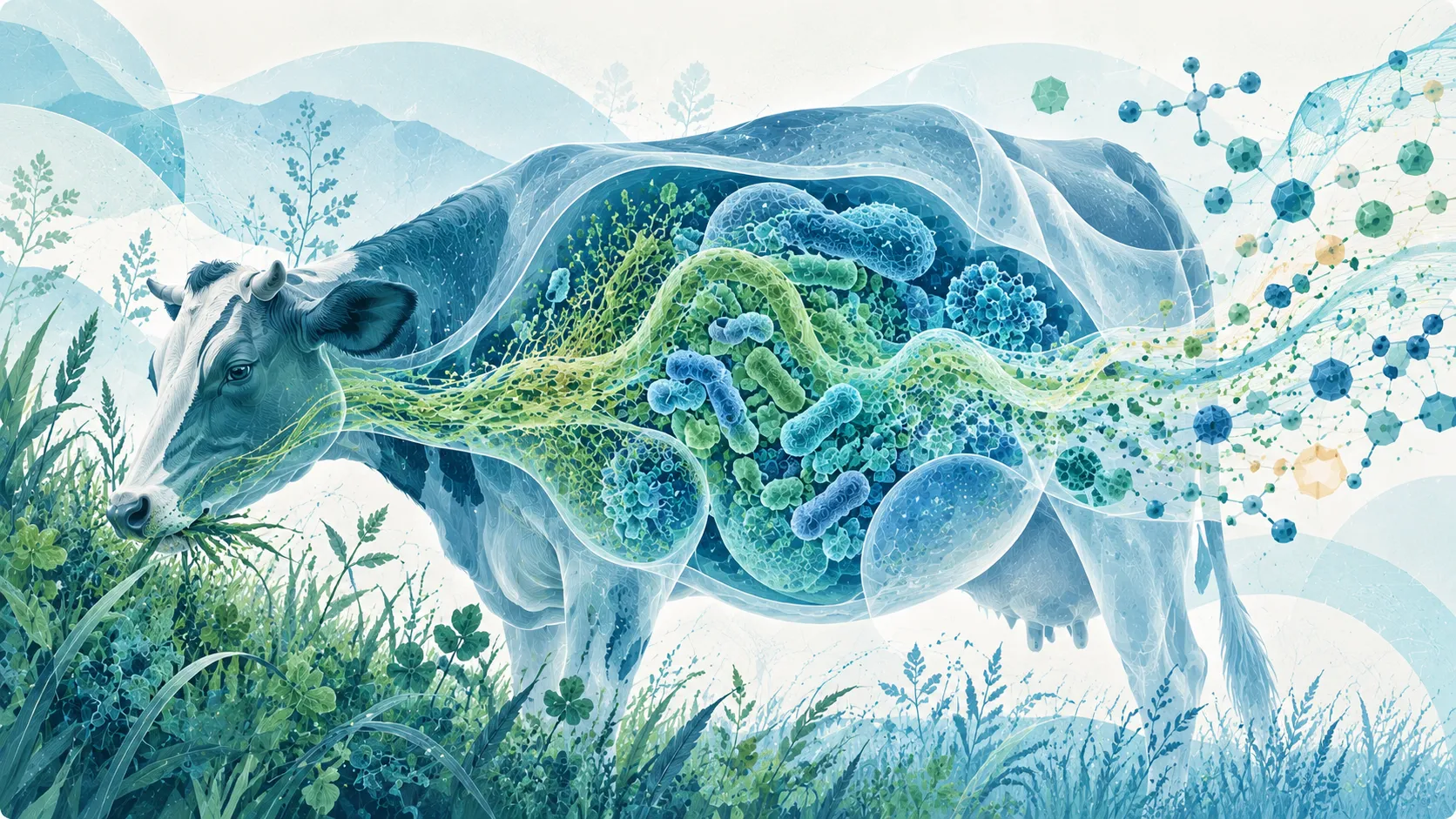
The ruminal microbiome is a dense, complex community of microbes in the forestomach of ruminants that enables digestion of fibrous plants and underpins global meat and milk production. It resides in the rumen, the first and largest of the four stomach compartments in cattle, sheep, and other ruminants, where strictly anaerobic, near-neutral pH (~6.0–6.8), and body-temperature (~39°C) conditions support microbial densities on the order of 10¹⁰–10¹¹ bacterial cells per milliliter of rumen fluid, alongside large populations of archaea, protozoa, fungi, and viruses. This community underpins production across a global ruminant livestock population numbering in the billions of animals, converting cellulose, hemicellulose, and other plant material that is otherwise indigestible to humans into meat, milk, and other nutrition. It is also a major source of methane, linking it directly to climate and sustainability debates. Current research focuses on describing this ecosystem, understanding how host and diet shape it, and exploring ways to engineer it for better productivity and lower emissions.
The rumen microbiome comprises an extremely diverse community of bacteria, archaea, protozoa, fungi, and viruses, with a core dominated by Bacillota and Bacteroidota plus a conserved set of methanogens (Henderson et al., 2015; Seshadri et al., 2018; Weimer, 2015). For the host, it supplies ~60–80% of energy and up to ~60–85% of absorbable amino acids via fermentation to VFAs and microbial protein, making it crucial for health and production (Keum et al., 2024; Liu et al., 2020; Mizrahi & Jami, 2018; Perez et al., 2024). Its composition is shaped by strong effects of diet, early-life colonization, and host genetics; adult communities show resilience and host-specific “states” (Cammack et al., 2018; Fernando et al., 2025; Huws et al., 2018; Malmuthuge & Guan, 2017; Moraïs & Mizrahi, 2019; Newbold & Ramos-Morales, 2020; O’Hara et al., 2020). Environmentally, rumen methanogens produce a large share of agricultural methane, but their comparatively limited diversity enables targeted mitigation strategies (Hassan et al., 2020; Henderson et al., 2015; Huws et al., 2018; Mizrahi et al., 2021; Mizrahi & Jami, 2018; Xie et al., 2021).
The rumen hosts a highly specialized and metabolically versatile microbial community that enables ruminants to thrive on fibrous, low‑quality plant material. Through the coordinated activity of bacteria, archaea, protozoa, and fungi, lignocellulose and non‑protein nitrogen are converted into volatile fatty acids, microbial protein, and essential vitamins; nutrients that collectively supply the majority of the animal’s energy and protein requirements (Keum et al., 2024; Liu et al., 2020; Mizrahi & Jami, 2018; Newbold & Ramos Morales, 2020; Perez et al., 2024; Seshadri et al., 2018). This metabolic capacity is underpinned by a vast gene repertoire that includes numerous carbohydrate‑active enzymes and nitrogen assimilation pathways, many of which have been revealed only recently through large-scale genomic initiatives.
The rumen is also spatially structured rather than a single well-mixed compartment: distinct microbial communities inhabit the liquid phase, the solid, fiber-adherent phase, and the epimural (epithelium-associated) surface, each with characteristic taxonomic and functional profiles that contribute differently to fermentation and host interaction (Cholewińska et al., 2020; De Mulder et al., 2016). This microhabitat structuring is increasingly recognized as an additional axis of functional diversity alongside taxonomic composition.
Despite the enormous diversity of microbial taxa in the rumen, a conserved “core microbiome” is consistently observed across ruminant species, diets, and continents. Genera such as Prevotella, Ruminococcus, Butyrivibrio, and several well‑established methanogens form a stable ecological backbone, while host genetics, diet composition, and management practices contribute to the variation layered on top of this shared core (Henderson et al., 2015; Mizrahi & Jami, 2018; Seshadri et al., 2018; Weimer, 2015). This combination of universality and adaptability allows ruminants to maintain digestive efficiency under a wide range of environmental conditions.
Another defining feature of the rumen microbiome is its strong functional redundancy and ecological resilience. Multiple taxa can perform overlapping metabolic roles—particularly in fiber degradation, hydrogen turnover, and fermentation—which enhances system stability but also makes long‑term manipulation in adult animals challenging (Fernando et al., 2025; Huws et al., 2018; Mizrahi & Jami, 2018; Moraïs & Mizrahi, 2019; Weimer, 2015). As a result, microbial interventions often yield transient effects unless they target early life, major dietary shifts, or underlying host‑microbe interactions.
Diet continues to be the most influential factor shaping rumen microbial structure and activity. Adjusting forage‑to‑concentrate ratios or supplementing feeds with oils, tannins, saponins, and phytogenic additives can alter fermentation pathways, enhance nitrogen utilization, and reduce methane emissions. However, these responses are frequently inconsistent across studies, reflecting the complexity and resilience of the microbial ecosystem (Hassan et al., 2020; Newbold & Ramos Morales, 2020; Sanjorjo et al., 2023; Xie et al., 2021). This variability underscores the need for precision approaches tailored to specific production systems. One of the more consistent successes in this area is the synthetic methanogenesis inhibitor 3-nitrooxypropanol (3-NOP), which blocks the enzyme methyl-coenzyme M reductase in methanogens; meta-analyses across dairy and beef cattle report enteric methane reductions on the order of 25–30% with sustained efficacy and no consistent negative effects on intake or fiber digestibility (Kebreab et al., 2023).
In contrast, early‑life manipulation appears far more promising for achieving persistent changes. Establishing a desirable microbiome during the initial colonization window, combined with selection for microbiome‑linked host traits such as feed efficiency or low methane emissions, offers a route to long‑lasting improvements in productivity and sustainability (Cammack et al., 2018; Huws et al., 2018; Malmuthuge & Guan, 2017; Mizrahi & Jami, 2018; O’Hara et al., 2020; Sanjorjo et al., 2023). These strategies align with the growing recognition that host genetics and microbial communities co‑develop and jointly determine phenotypes.
The rapid expansion of metagenomic databases, cultured strain collections, and genome catalogs is accelerating progress in this field. Resources such as the Hungate1000 collection and rumen gene catalogs now make it possible to target specific microbial genes and pathways—including those involved in methanogenesis, hydrogen metabolism, vitamin biosynthesis, and fiber degradation—to guide breeding programs, optimize feed formulation, and design more precise microbiome interventions (Huws et al., 2018; Mizrahi et al., 2021; Seshadri et al., 2018; Xie et al., 2021). These tools mark a shift from descriptive microbiome research toward mechanistic and eventually engineering‑based approaches.
Conclusion
The rumen microbiome is a diverse yet structured ecosystem that meets most of a ruminant’s nutritional needs while contributing substantially to methane emissions. Its composition reflects interactions among diet, early‑life colonization, and host genetics, producing a resilient community with a shared core but individualized ecological “states.” Advances in omics, microbial ecology, and targeted nutritional or genetic tools are shifting the field from descriptive research toward intentional engineering for more efficient and lower‑emission ruminant production.
References
Cammack, K., Austin, K., Lamberson, W., Conant, G., & Cunningham, H. (2018). Ruminant Nutrition Symposium: Tiny but mighty: the role of the rumen microbes in livestock production. Journal of Animal Science, 96(2), 752–770. https://doi.org/10.1093/jas/skx053
Cholewińska, P., Czyż, K., Nowakowski, P., & Wyrostek, A. (2020). The microbiome of the digestive system of ruminants – a review. Animal Health Research Reviews, 21, 3–14. https://doi.org/10.1017/s1466252319000069
De Mulder, T., Goossens, K., Peiren, N., Vandaele, L., Haegeman, A., De Tender, C., Ruttink, T., Van De Wiele, T., & De Campeneere, S. (2016). Exploring the methanogen and bacterial communities of rumen environments: solid adherent, fluid and epimural. FEMS Microbiology Ecology, 93(3). https://doi.org/10.1093/femsec/fiw251
Fernando, S., Adams, S., Lakamp, A., & Spangler, M. (2025). Stochastic and deterministic factors that shape the rumen microbiome. Journal of Dairy Science. https://doi.org/10.3168/jds.2024-25797
Hassan, F., Arshad, M., Ebeid, H., Rehman, M., Khan, M., Shahid, S., & Yang, C. (2020). Phytogenic Additives Can Modulate Rumen Microbiome to Mediate Fermentation Kinetics and Methanogenesis Through Exploiting Diet–Microbe Interaction. Frontiers in Veterinary Science, 7. https://doi.org/10.3389/fvets.2020.575801
Henderson, G., Cox, F., Ganesh, S., Jonker, A., Young, W., Abecia, L., … & Janssen, P. (2015). Rumen microbial community composition varies with diet and host, but a core microbiome is found across a wide geographical range. Scientific Reports, 5. https://doi.org/10.1038/srep14567
Huws, S., Creevey, C., Oyama, L., Mizrahi, I., Denman, S., Popova, M., … & Morgavi, D. (2018). Addressing Global Ruminant Agricultural Challenges Through Understanding the Rumen Microbiome: Past, Present, and Future. Frontiers in Microbiology, 9. https://doi.org/10.3389/fmicb.2018.02161
Kebreab, E., Bannink, A., Pressman, E., Walker, N., Karagiannis, A., van Gastelen, S., & Dijkstra, J. (2023). A meta-analysis of effects of 3-nitrooxypropanol on methane production, yield, and intensity in dairy cattle. Journal of Dairy Science, 106, 927–936. https://doi.org/10.3168/jds.2022-22211
Keum, G., Pandey, S., Kim, E., Doo, H., Kwak, J., Ryu, S., Choi, Y., Kang, J., Kim, S., & Kim, H. (2024). Understanding the Diversity and Roles of the Ruminal Microbiome. Journal of Microbiology, 62, 217–230. https://doi.org/10.1007/s12275-024-00121-4
Liu, K., Zhang, Y., Yu, Z., Xu, Q., Zheng, N., Zhao, S., Huang, G., & Wang, J. (2020). Ruminal microbiota–host interaction and its effect on nutrient metabolism. Animal Nutrition, 7, 49–55. https://doi.org/10.1016/j.aninu.2020.12.001
Malmuthuge, N., & Guan, L. (2017). Understanding host-microbial interactions in rumen: searching the best opportunity for microbiota manipulation. Journal of Animal Science and Biotechnology, 8. https://doi.org/10.1186/s40104-016-0135-3
Mizrahi, I., & Jami, E. (2018). Review: The compositional variation of the rumen microbiome and its effect on host performance and methane emission. Animal, 12(S2), S220–S232. https://doi.org/10.1017/s1751731118001957
Mizrahi, I., Wallace, R., & Moraïs, S. (2021). The rumen microbiome: balancing food security and environmental impacts. Nature Reviews Microbiology, 19, 553–566. https://doi.org/10.1038/s41579-021-00543-6
Moraïs, S., & Mizrahi, I. (2019). The Road Not Taken: The Rumen Microbiome, Functional Groups, and Community States. Trends in Microbiology, 27(6), 538–549. https://doi.org/10.1016/j.tim.2018.12.011
Newbold, C., & Ramos‑Morales, E. (2020). Review: Ruminal microbiome and microbial metabolome: effects of diet and ruminant host. Animal, 14(S1), S78–S86. https://doi.org/10.1017/s1751731119003252
O’Hara, E., Neves, A., Song, Y., & Guan, L. (2020). The Role of the Gut Microbiome in Cattle Production and Health: Driver or Passenger? Annual Review of Animal Biosciences, 8, 199–220. https://doi.org/10.1146/annurev-animal-021419-083952
Perez, H., Stevenson, C., Lourenco, J., & Callaway, T. (2024). Understanding Rumen Microbiology: An Overview. Encyclopedia. https://doi.org/10.3390/encyclopedia4010013
Sanjorjo, R., Tseten, T., Kang, M., Kwon, M., & Kim, S. (2023). In Pursuit of Understanding the Rumen Microbiome. Fermentation. https://doi.org/10.3390/fermentation9020114
Seshadri, R., Leahy, S., Attwood, G., Teh, K., Lambie, S., Cookson, A., … & Kelly, W. (2018). Cultivation and sequencing of rumen microbiome members from the Hungate1000 Collection. Nature Biotechnology, 36, 359–367. https://doi.org/10.1038/nbt.4110
Weimer, P. (2015). Redundancy, resilience, and host specificity of the ruminal microbiota: implications for engineering improved ruminal fermentations. Frontiers in Microbiology, 6. https://doi.org/10.3389/fmicb.2015.00296
Xie, F., Jin, W., Si, H., Yuan, Y., Tao, Y., Liu, J., Wang, X., … & Mao, S. (2021). An integrated gene catalog and over 10,000 metagenome-assembled genomes from the gastrointestinal microbiome of ruminants. Microbiome, 9. https://doi.org/10.1186/s40168-021-01078-x